Visibility: see if AI can reach, read and cite your pages
Before ChatGPT, Perplexity, Gemini, or Claude ever cites you, 3 things have to happen in order: they have to find your page, open it, and pick it as a source. Visibility tests all three, page by page, before you change a word.
Ranking in Google and being cited by AI are different outcomes.
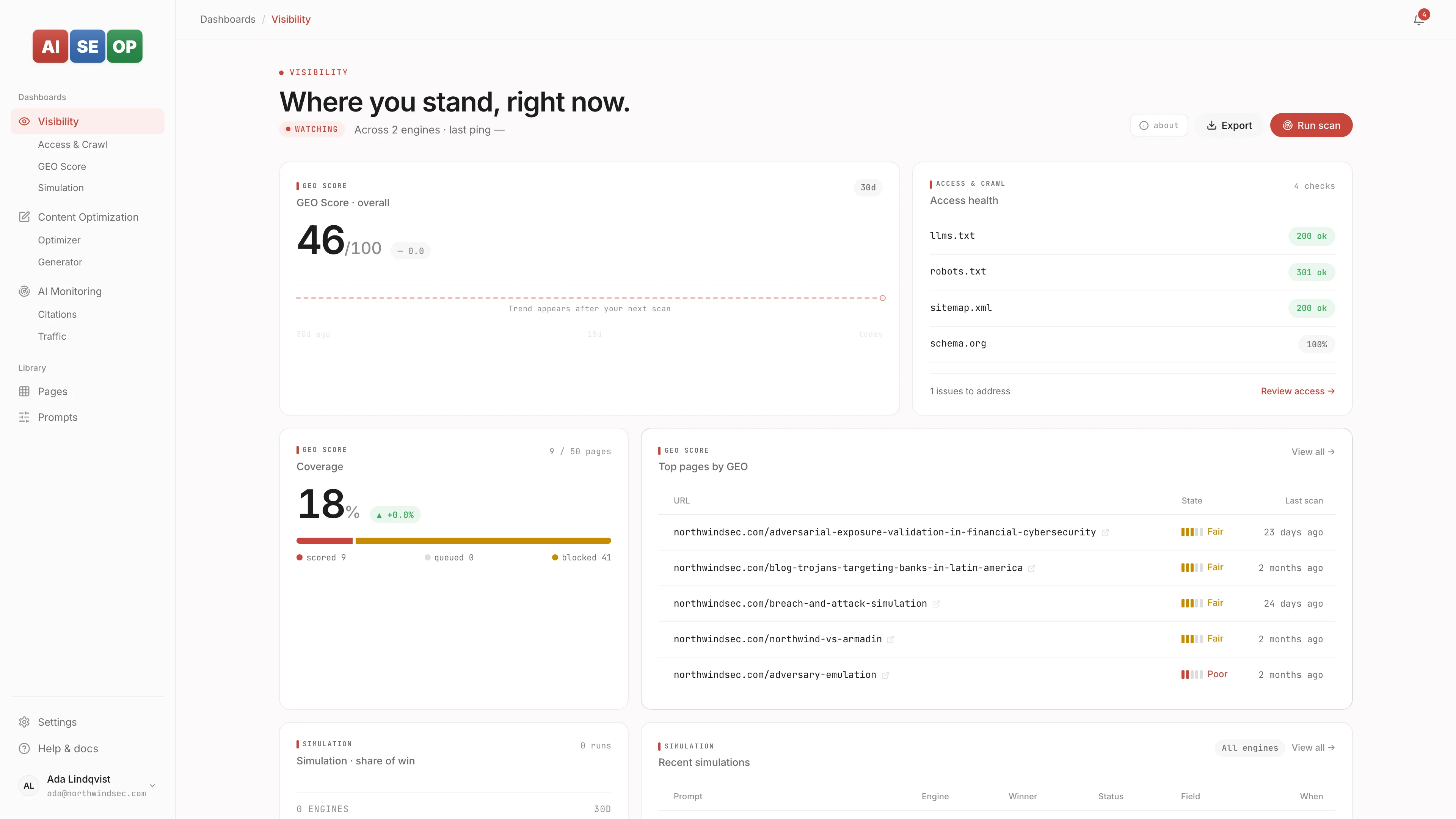
A page can rank well and still be invisible to an AI answer because it is never retrieved, never opened, or opened and skipped as unconvincing. Each gate limits what happens next: Visibility diagnoses the problem, Content Optimization provides the fix, and AI Monitoring shows whether the fix worked.
The gate: AI has to reach you first.
A page bots cannot reach cannot be cited, regardless of how well it reads. Access & Crawl checks that before anything else.
- Verify llms.txt, robots.txt, and sitemap.xml through Site Foundations.
- Test live reachability for each bot using its real user agent.
- Measure discoverability across top-10, top-30, top-100, or not-found results.
The Site Foundations wizard detects site identity from the homepage, reads titles and descriptions, and writes an llms.txt file with CMS-specific deployment steps. The reachability test runs live GET requests using each AI bot's real user agent, separates citation bots from training crawlers, and identifies the exact cause and fix behind every block. Citation bots determine AI search visibility, while training crawlers do not affect AI search results.
A sample Access score was 90/100, with 20 of 20 AI crawlers allowed, llms.txt returning 200, robots.txt returning 301, sitemap.xml returning 200, and discoverability at 25% retrievable across 4 of 16 tracked prompts.
Every page, scored for how ready it is to be cited.
GEO Score rates every tracked page from 0 to 100 and sorts them so the pages holding you back come first. It is the core page-readiness check in Visibility.
- Sort pages into five states: Critical, Poor, Fair, Good, and Excellent.
- Score four categories: Content Structure, Structured Data, Authority Signals, and Citability.
- Open any row to see the exact issue breakdown.
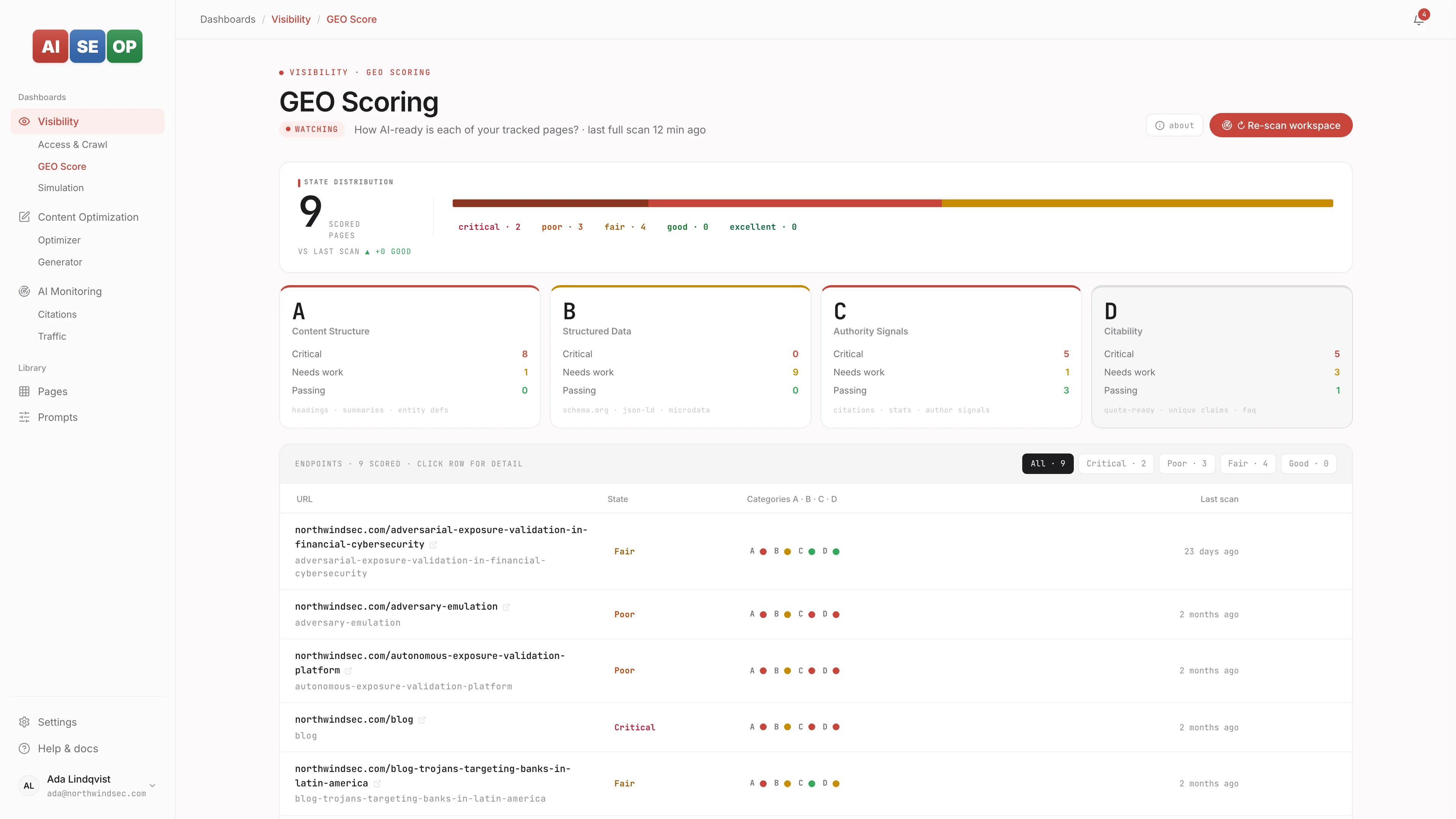
An Excellent page is AI-ready across all four categories, from A through D. A Critical page is difficult for large language models to extract or cite. In one first scan of 9 pages, 2 were critical, 3 were poor, and 4 were fair, producing an overall GEO score of 46/100.
Simulate your page before you publish it.
Put a live page, an Optimizer version, or an unpublished draft in front of a real AI engine and see whether it gets picked, before anyone else sees the page.
- Simulate an unpublished draft or optimized version before it goes live.
- Track the Listed, Fetched, Cited funnel and receive a fix for each stage.
- Save every run to compare results before and after a fix.
The engine assembles a shelf of real search results with real body text and writes its answer from that shelf. The interface tells you when your page was placed on the shelf; the real test begins at Fetched. Each run repeats three times, so consistency becomes a measurable result.
One run cited the tested page on snippet strength alone, without it ever being opened. Across the sample, the page was selected in 2 of 3 runs, ranked #2 among 24 rivals on a shelf of 25 sources, and was cited in 80% of runs at an average position of #2.0.
Access opens the gate. GEO Score prepares the page. Simulation proves it.
Access runs before anything is scored. All three checks feed into Content Optimization for fixes, while AI Monitoring tracks the results over time.
See where you stand before you change a word.
Run a free scan with no card required to preview the results and see which gate is closing before an AI engine reaches your content. To see Access & Crawl, GEO Score, and Simulation on your own pages, book a demo.